

You know that feeling when you walk through your front door after a long, exhausting day, ready to relax, but the first thing you do is trip over a stray sneaker? Or maybe you spend ten frantic minutes every morning hunting for car keys that seem to have vanished into thin air.
If this sounds familiar, you aren’t alone. The entryway is the most trafficked area of any home, yet it’s often the most neglected. Whether you have a dedicated mudroom or just a small slice of wall by the door, clutter here sets the wrong tone for the rest of your house.
This brings us to the core of the problem: a lack of proper entryway organization. It’s not just about making things look pretty on Instagram; it’s about creating a functional system that handles the real-life mess of backpacks, muddy boots, and wet umbrellas.
In this guide, I’m going to walk you through practical, smart solutions to transform your chaotic drop zone into a welcoming, organized space—regardless of your square footage.
Why Prioritizing Entryway Organization Changes Everything
Let’s be honest for a second. We often obsess over organizing the pantry or color-coding the bookshelf, but the entryway is the handshake of your home. It greets you and your guests first.
I remember helping a friend in Chicago who had a tiny apartment. During winter, her front door area became a disaster zone of slushy boots and heavy coats. She thought she needed a bigger house. She didn’t. She just needed smarter entryway organization. Once we installed a vertical system and a proper boot tray, her entire morning routine became smoother. She stopped leaving the house stressed.
When you have a designated spot for everything, you stop losing time. Plus, keeping the dirt contained at the door saves your floors and your sanity.
Step 1: Analyze Your “Drop Zone” Habits
Before we buy a single basket or hook, we need to look at how you actually use the space. Don’t try to change your family’s personality; design around it.
Stand in your entryway and ask yourself:
- What lands on the floor? (Shoes, bags, mail?)
- Who is the biggest clutter culprit? (Kids throwing backpacks, or you dropping your purse?)
- What is the weather like? (Do you need space for bulky snow gear or just light jackets?)
If you live in a rainy area like Seattle or London, waterproofing your storage is key. If you are in a dry climate, maybe dust control is the priority. Understanding these habits is the foundation of solid entryway organization.
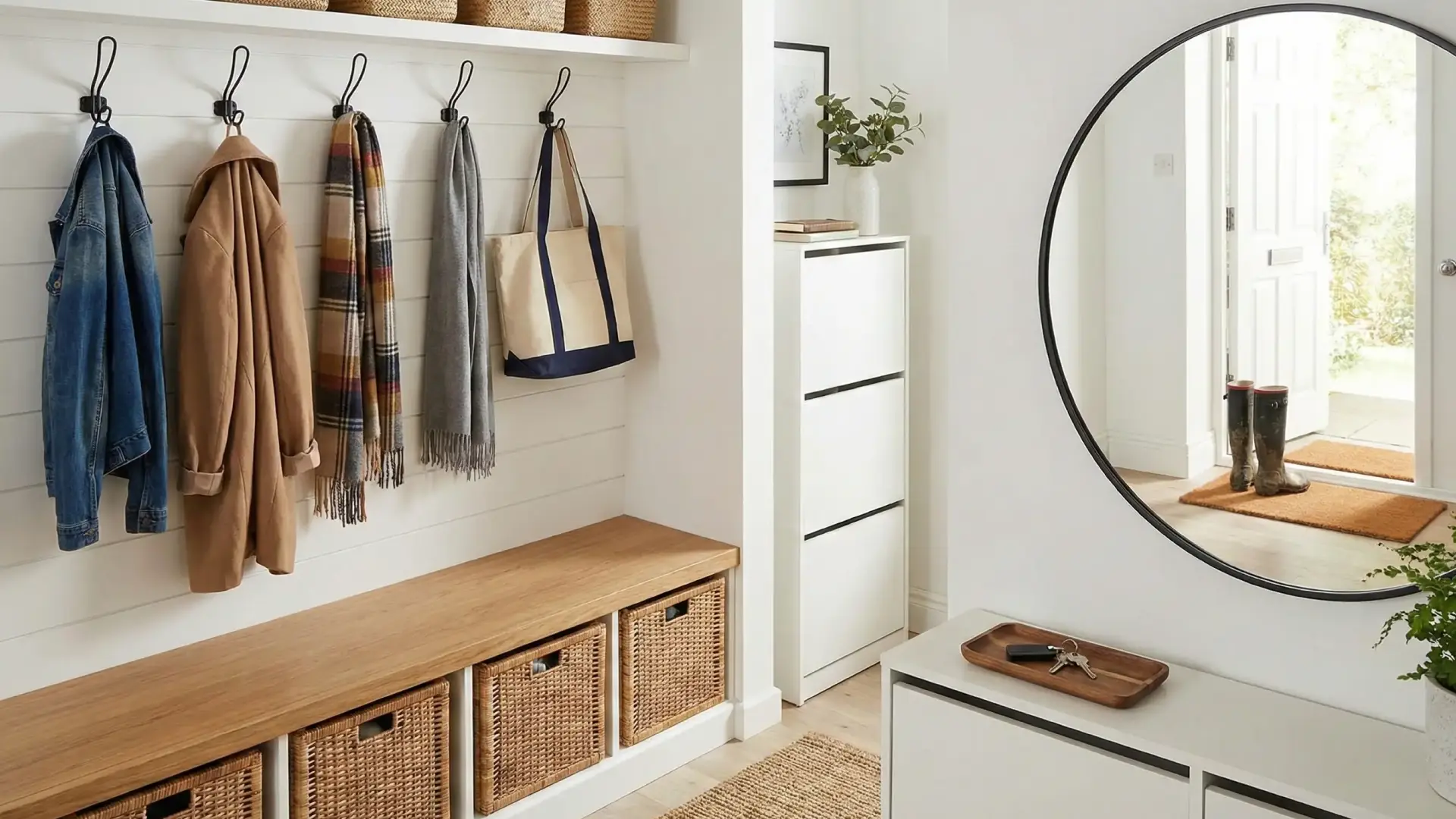
Step 2: Vertical Storage is Your Best Friend
Most people look at the floor space and think, “I don’t have room.” But look up! The walls are prime real estate that often goes unused.
Hooks: The Unsung Heroes
For immediate grab-and-go convenience, nothing beats a sturdy hook. But here is a pro tip: install them at different heights.
- High Level (60+ inches): For adult coats and barely-used hats.
- Mid Level (40-48 inches): For purses, scarves, and everyday jackets.
- Low Level (30-36 inches): This is magic for kids. If they can reach the hook, they might actually use it.
[Insert Link Here: (Affiliate link to heavy-duty, decorative double hooks or a wall-mounted coat rack)]
Using double hooks gives you twice the storage in the same footprint. I switched to these last year, and suddenly I had room for both my heavy winter coat and my dog’s leash on the same bracket.
Floating Shelves and Cubbies
If you have a narrow hallway, bulky furniture isn’t an option. Floating shelves keep the floor clear while giving you a spot for decor or baskets. A shelf with hooks underneath is a classic combo that works in almost every style of home, from Farmhouse to Modern Minimalist.
Step 3: Taming the Shoe Mountain
Shoes are the number one cause of entryway chaos. Without a system, they multiply.
The “One Pair” Rule
This is a tough one, but effective. Keep only the shoes you wear currently in the entryway. The dress shoes you wear once a year belong in the bedroom closet, not cluttering your prime entryway organization zone.
Slim Shoe Cabinets
If you haven’t seen the tilt-out shoe cabinets (like the popular ones from IKEA), they are a game-changer for narrow spaces. They are usually only about 7 to 10 inches deep. You can store 8-12 pairs of shoes tucked away behind a clean facade, and you still get a surface on top for your keys and mail.
[Insert Link Here: (Affiliate link to a slim, tilt-out shoe cabinet or a stylish wooden shoe rack)]
Boot Trays for Weather Protection
For my readers in snowy or rainy regions, a boot tray is non-negotiable. It catches the mud and melting snow, protecting your hardwood or carpet. Fill it with river stones for a spa-like look that allows water to drain away from the soles of your boots.
Step 4: The Bench – Combining Comfort and Storage
If you have at least 3-4 feet of width, add a bench. Why? Because nobody likes hopping on one foot while trying to tie a sneaker.
But don’t just buy a bench for sitting. It must double as storage.
- Flip-top benches: Great for storing off-season items like winter blankets or sports gear.
- Open-bottom benches: Perfect for sliding baskets underneath to hide clutter.
I once found an old church pew at a flea market, cut it down to size, and used it in a client’s mudroom. It added so much character and provided a sturdy place for the kids to put on their cleats.
Step 5: The “Landing Strip” for Small Items
You know the panic of “Where are my keys?!” We are going to fix that forever. You need a dedicated “Landing Strip.” This is a small, specific zone for the items in your pockets.
The Console Table or Shelf
If space permits, a narrow console table is perfect. Place a decorative bowl or a small tray on it. When you walk in, keys, wallet, and sunglasses go only in that tray. Muscle memory will take over after a week, and you’ll never lose your keys again.
Handling the Mail
Paper clutter accumulates fast. Create a simple sorting system right at the door:
- Action: Bills or forms to sign.
- Recycle: Junk mail goes here immediately (don’t even bring it further into the house).
- File: Items to keep.
A small wall-mounted mail organizer can handle this without taking up table space.
Step 6: Baskets are the Secret Weapon
If I could only choose one item for entryway organization, it would be baskets. They hide a multitude of sins.
Use woven baskets, wire bins, or fabric cubes to categorize items.
- One basket for winter gear: Hats, gloves, scarves.
- One basket for pet supplies: Leashes, waste bags, treats.
- One basket for “returns”: Things that need to go back to the store or to a friend.
Labeling these baskets is crucial, especially if you live with other people. If a basket is just a “black hole,” it will get filled with trash. If it says “Gloves,” there is a 90% higher chance only gloves will end up inside.
Step 7: Lighting and Mirrors
Organization isn’t just about storage; it’s about perception. A dark, cramped entryway feels more cluttered than it actually is.
Mirrors Create Space
Hanging a large mirror above your console table or bench reflects light and makes a narrow hallway feel twice as big. Plus, it lets you do a quick “teeth check” before you run out the door.
Proper Lighting
Don’t rely on a single, dim overhead bulb. If you have a deep closet or a dark corner, use battery-operated motion sensor lights. Being able to actually see inside your closet encourages you to keep it tidy.
Making It Stick: The Maintenance Routine
You can build the most beautiful mudroom in the world, but without maintenance, chaos will return. Here is the routine I recommend to keep your entryway organization intact:
The Friday Reset: Once a week (I do this on Fridays), spend 5 minutes clearing the entryway.
- Put away shoes that have migrated there but aren’t being used.
- Empty the “Action” mail bin.
- Shake out the rugs or boot trays.
It takes five minutes, but it ensures you start your weekend with a clean slate.
Final Thoughts: Welcome Home
Transforming your entryway doesn’t require a contractor or a massive budget. It requires looking at your space with fresh eyes and prioritizing function.
Start small. Maybe today you just buy that boot tray or install those hooks. Even small changes in entryway organization can have a massive ripple effect on how your home feels.
You deserve to walk through your door and feel a sense of relief, not stress. So, grab that tape measure, clear out the old junk, and reclaim your entryway.
Post By SJ SINAN


Leave a Comment